

PERCOLATOR - ITS INVENTOR PUT THE HOLE IN POT HANDLES
PERCOLATOR - ITS INVENTOR PUT THE HOLE IN POT HANDLES

PERCOLATOR - ITS INVENTOR PUT THE HOLE IN POT HANDLES
Who’d have thought a coffee percolator and a pair of long johns had anything in common. Both were invented by a turncoat American physicist, Sir Benjamin Thompson
Thompson, (below) better known in scientific circles as Count Rumford, is credited with, among other things, the drip coffee maker, the double boiler, the earliest version of the modern cook stove, school lunch and those holes in your sauce pot handles. He’d have been a pretty handy guy in a colonial Boston kitchen, save the fact he was a Tory.
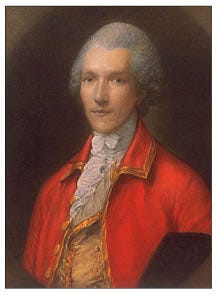
Born of modest means in Woburn, Massachusetts, in 1753, he was apprenticed at 13 to help with the family finances. Successful in some jobs and not so much in others, his circumstances improved overnight when he married a wealthy young widow in 1772. Alas, Ben chose the wrong side in the Revolutionary War, serving in the King’s Royal Dragoons, spying for the British Army and recruiting loyalists to fight for England. He fled to London to save his hide when the war ended, abandoning his wife and a young daughter.
After winning scientific accolades in London,Thompson became an ex-pat for a second time, spending a dozen years in Bavaria as aide-de-camp to Prince-elector Charles Theodore. He piled up a bevy of accomplishments there, including thermal underwear, improved rations for the Bavarian army and his icky-but-nutritious “Rumford Soup.” Prison inmates, orphans in foundling schools and workhouse residents were the lucky osup guinea-pigs. Equal parts pearl barley and dried peas, four parts potato, salt, and sour beer, it was boiled until thick and eaten with bread.* Sound yummy? Better than starving, perhaps, but nobody promised it tasted good. There was, however, a net positive affect, bringing about the cultivation of potatoes across Bavaria. His thermal underwear, however, proved to be a lot more popular than the soup.
In what only looked like a complete departure from poor-folk stew and Army rations, Rumford designed Munich’s Englischer Garten (English Garden) in 1789. It’s still one of the largest urban public parks in the world. Strung out over more than 900 acres in central Munich, it was developed not for the public’s benefit but as a way to keep the Prince’s peacetime soldiers busy farming.
Returning to England, the scientific vagabond, created a sensation again with the smoke-free Rumford fireplace and the founding of the country’s premier scientific organization, the Royal Institution of Great Britain.
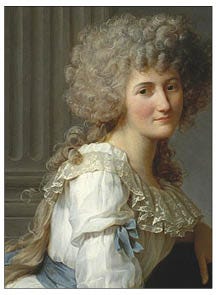
Seven years after the death of his abandoned American wife, he married Marie-Anne Lavoisier, (above) widow of the famed French chemist, Antoine Lavoisier, of the “Table of Elements” fame. Rumford, ever a poor candidate for matrimony, separated from the widow Lavoisier three short years later.
His long suffering American daughter, Sarah, finally joined her father in London following her mother died, dividing her time between London and New England. Rumford never returned to the land of his birth, buried in Paris in 1814 at the age of 61. Sarah, (below) however did return, arriving with the inherited Rumford title and a tidy pension compliments of the Bavarian government.
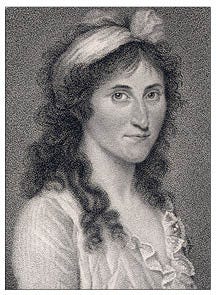
She lived her later years in Concord, New Hampshire, with her adopted daughter, devoting much of the Rumford money to charity and establishing the Rolfe and Rumford Asylum for the homeless in Concord. After her death in 1854, she left most of her fortune to a variety of New England institutions for widows, homeless girls and the mentally ill. A hundred and thirty years later, in 1984 the United Way organization founded the Rumford Foundation as a memorial, not to the Count but to Sarah, returning the Rumford name to national respectability.
*Not for the faint of heart, an updated version of Rumford Soup which promises to be tastier than the original, is on line at britishfoodinamerica.com. Said to yield “six cheap and cheerful servings” it’s vegan approved.